
A two-year programme to renew seven life-expired timber groynes between East Cliff and Boscombe Beach.

Lead Authority
BCP Council
Contractor
Budget
£2.3 million
Project start date
October 2025
Anticipated completion
March 2027
Page Last Updated
6 March 2026

Seven life-expired groynes due for replacement 2025 – 2027
The Project
All 53 timber groynes along Bournemouth’s beaches are being renewed, in multiple short phases, as part of the Poole Bay Beach Management Scheme 2015-2032
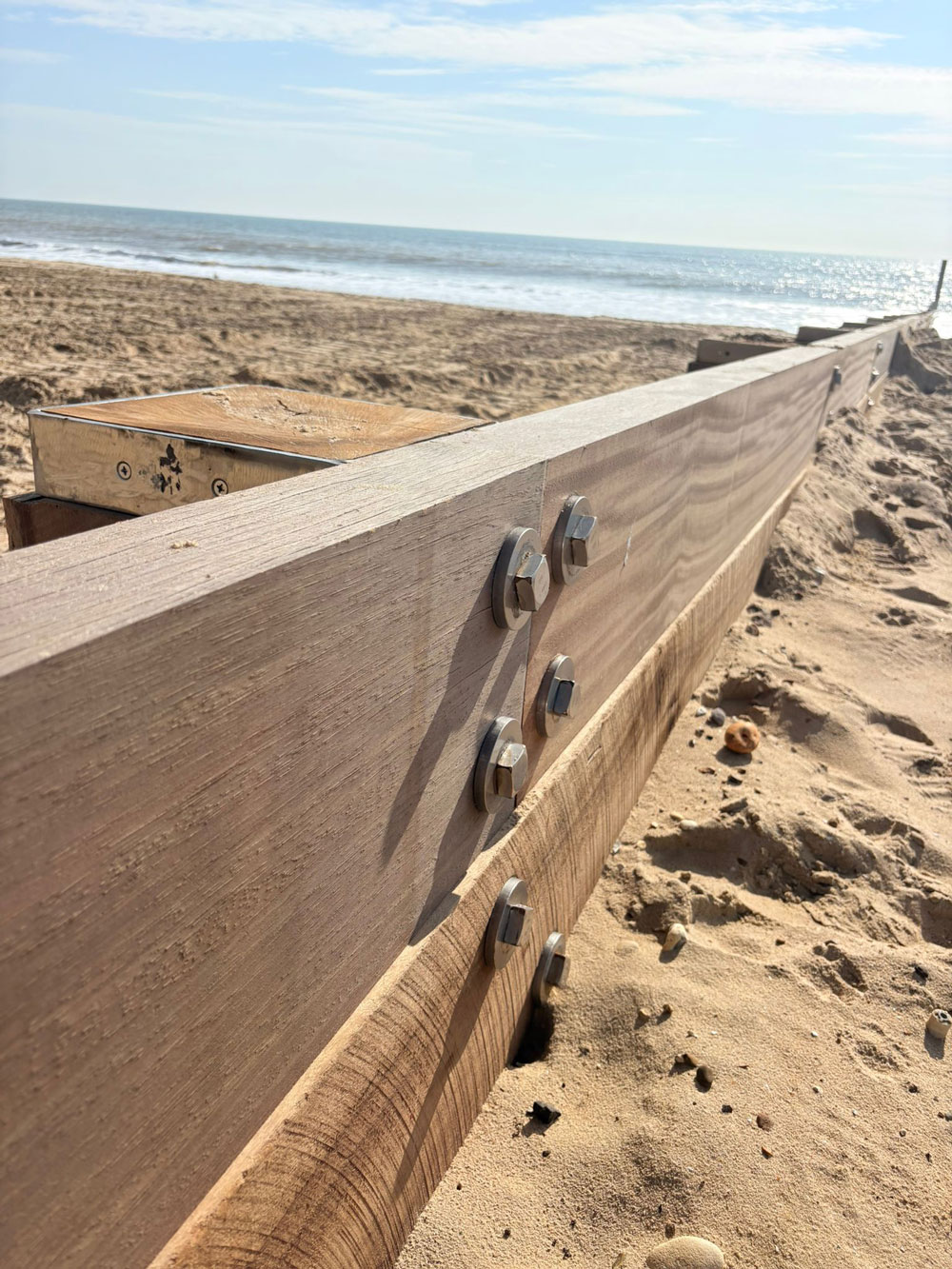
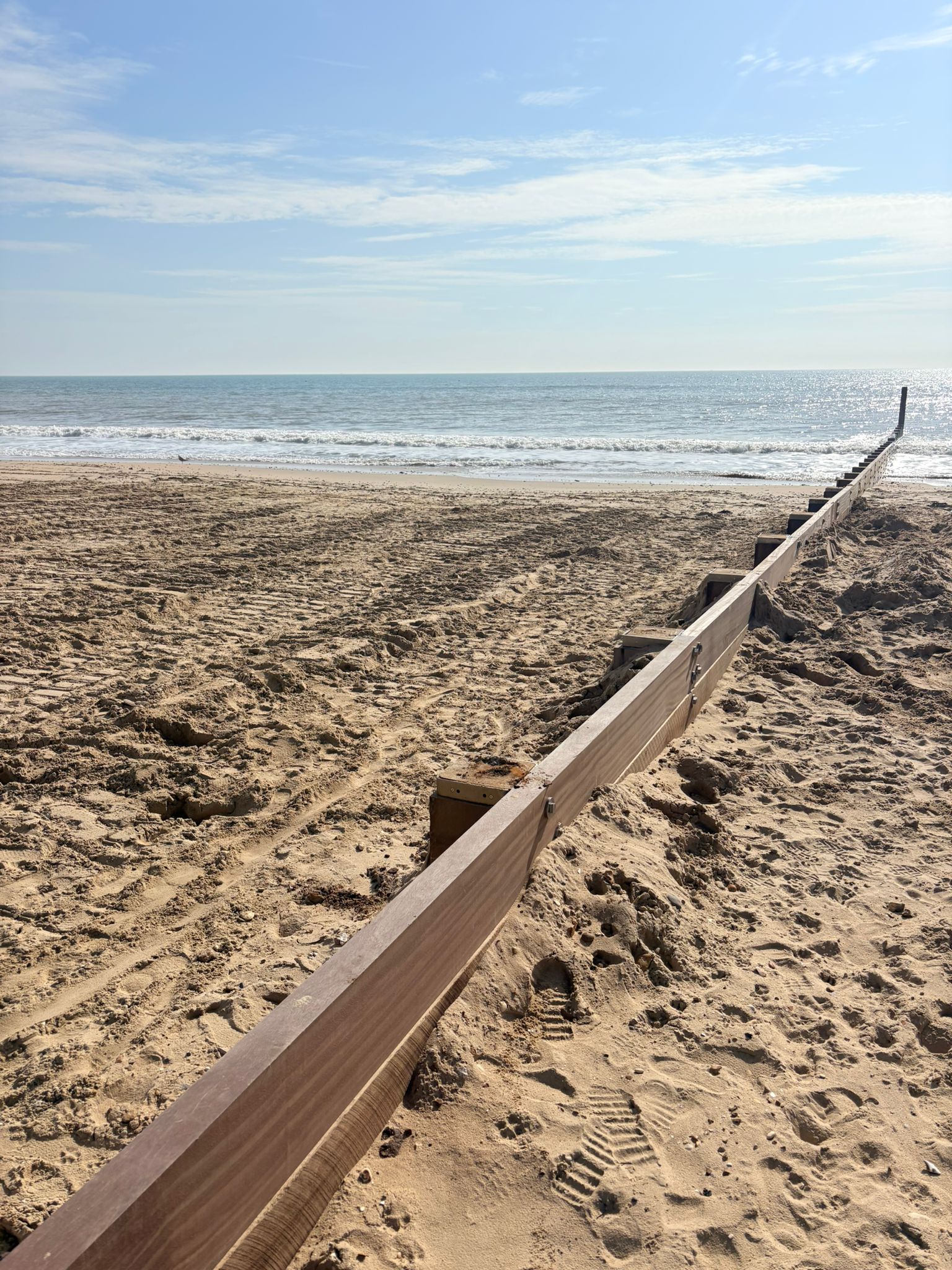
Over the winters of 2025/26 and 2026/27 we are renewing seven life-expired groynes between East Cliff and Boscombe Beach. We started at East Cliff, where our contractor Suttle Projects completed the first two groyne renewals (Year 1a) in December 2025.
The renewal of two groynes at Boscombe East (Year 1b) was completed and the beach re-opened on 5 March 2026.
Order of works
The order of works for this 2-year project has been planned according to the condition of the existing groynes – for locations please refer to the map at the top of the page.
| Location | Duration of works | Works | |
|---|---|---|---|
| Year 1a, winter 2025/26 | East Cliff | Oct - Dec 2025 | 2 timber groynes replaced |
| Year 1b, winter 2025/26 | Boscombe Beach East | Jan - Mar 2026 | 2 timber groynes replaced |
| Year 2, winter 2026/27 | Boscombe Beach West | Oct 2026 - Mar 2027 | 3 timber groynes to be replaced |
Piling operations at East Cliff, November 2025
Why these works are needed
The groyne replacement programme forms part of the Poole Bay Beach Management Scheme, designed to help protect our coastline from erosion for the next 100 years.
Groynes are replaced approx every 25 years, when they become life expired. The groynes slow down the natural coastal process that moves beach material from west to east in Poole Bay.
Piling and planking deep into the beach, to the first solid layer of clay, helps retain the sand. Combined with periodic beach re-nourishment, the groynes and beach provide vital protection to the seawalls and cliffs from erosion.
Access during the works
The promenade will remain open but for safety reasons, the affected length of beach will be fenced off during the works.
The sand becomes very unstable when it is excavated around groynes (see image below). For this reason, we ask all beach visitors to avoid the construction zone along the water’s edge, even at low tide. Dogs should be kept on a lead.
Once work is finished, restrictions will remain in place until the sand dries out and becomes more compact and stable underfoot
Timber used for the new groynes
Each new groyne will be constructed using a mix of new tropical hardwood timber and recycled tropical hardwood planking, from previously deconstructed timber groynes, when available.
Hardwoods used will be Greenheart - a pale yellow to dark olive green wood from Guyana, South America, and Ekki - a dark red / deep chocolate-brown wood from West Africa and the Congo. These timbers have been selected for their strength, durability and resistance to marine life which can destroy wood by boring into and eating it.
What's eating our timber groynes?
Gribble! These tiny worms (Limnoria terebrans) were first discovered in 1799 and they attack marine timbers. Gribble burrow into groyne timbers, creating long tunnels just beneath the surface; the holes they leave behind eventually weaken the wood, causing it to crumble and rot. This is one of the reasons we renew our groynes every 25 years approx.
Gribble resemble tiny yellowy-pink lice about the size of a grain of rice, but they are actually very small crustaceans. Crustaceans are animals that usually have a hard covering, or exoskeleton, jointed legs and two pairs of antennas, or feelers. Other examples of crustaceans are crabs, lobsters, shrimps, and barnacles.
FUNKY FACTS ABOUT POOLE BAY GROYNES
A total of 29 piles are sunk for a timber groyne, each pile is 10m long and spaced 2.5m apart. The King pile (out at sea) is 12.5m long. Piles are driven down to the first solid layer of stable substrate/clay. Each groyne is between 5m-7.5m deep and roughly 75m in length. Approximately 225 planks of timber make up a groyne. Generally only the top 5 rows are constructed using new timber; recycled timber is used for the bottom 12-14 rows. Timbers unsuitable for re-use on new groynes are recycled for other projects; for example in 2022, for cladding and decking at Durley Hub at Durley Chine, and as part of a footbridge created at a flooded wetland scheme in the Tamar Valley AONB, Cornwall.
You'll find more information on projects that reuse BCP groyne timber at our Recycling & Reusing page.
Environmental considerations
All the groyne renewal works will be carried out in accordance with the Marine Management Organisation licence and planning consent. Additionally, new tropical hardwood timber used for this project is certified sustainable by the Forestry Stewardship Council (FSC).
The old groynes will be carefully deconstructed to ensure that all suitable materials can be recovered and recycled or re-used in future coastal projects.
Groynes - their role in coast protection
Beach material generally moves from west to east in Poole Bay. The strategically placed groynes are renewed approximately once every 25 years and slow down the natural processes. Piling and planking deep into the beach to the first solid layer of substrate/clay helps retain the sand within the groyne field.
In combination with periodic beach renourishment (topping-up the beach levels) the groynes also help protect the seawalls and cliffs from erosion. We last renourished some of the beaches from Poole to Southbourne in early 2021 [project details here].
Previous phases of timber groyne renewal:
- October 2024 · 2 life-expired timber groynes replaced at Hengistbury Head Beach and strengthened with rock at the seaward end – making efficient use of plant & materials on site for the Long Groyne upgrade
- Winter 2022-24 · 7 groynes from west of Bournemouth Pier to just below the East Cliff Lift
- Winter 2020-22 · 8 groynes eastwards from the Poole/Bournemouth boundary to West Cliff zig-zag
- Winter 2017-19 · 12 groynes at Southbourne from St Catherine’s Path to the eastern end of the promenade
- Winter 2016/17 · 8 groynes eastwards from Fisherman’s Walk to Gordon’s Corner
- Winter 2015/16 · 10 groynes from the east of Boscombe Pier to Fisherman’s Walk